The Operator's Guide to a One Person Business

By Alan Martin

You've spent a decade making someone else's business work. You've managed teams, hit revenue targets, built systems that ran without you, and sat through enough all-hands meetings to know that the people setting strategy aren't smarter than you. They just own the thing.
The question isn't whether you can run a business. You already know you can. The question is whether the economics make sense right now and whether going independent is a calculated move or a midlife crisis with the obligatory LinkedIn announcement.
What's changed is that AI has collapsed the overhead equation. One competent operator with the right stack can now handle the task load that used to require three to five contractors or employees: content production, research, design, admin, even full-on software development. Not in a theoretical, "someday the robots will save us" sense. Right now, with tools that cost less than your monthly coffee budget.
This isn't a motivational piece about quitting your job and finding your purpose.
It's an operating model.
A one person business in 2026 isn't a compromise or a stepping stone. For a skilled operator with AI infrastructure, it's THE optimal structure.
What a One Person Business Actually Is (And Isn't)
A one person business is a company owned and operated by a single individual who controls strategy, client relationships, and revenue. Unlike freelancing, it uses systems, AI tools, and selective outsourcing to deliver at scale. No employees, partners, or traditional overhead. The "one person" refers to one decision maker, not one pair of hands.
That distinction matters.
Tim Denning and others like to point out that most "one person businesses" quietly use contractors, virtual assistants, and tools. He's right. The "one person" label isn't about doing everything yourself. It's about one P&L owner, one strategic brain, zero org chart. You might hire an editor, a bookkeeper, or a specialist for a specific project. What you don't have is employees, partners with equity, or a management layer between you and revenue.
This is different from freelancing, which is trading time for money WITHOUT leverage. A freelancer bills hours. A one person business builds systems that deliver outcomes, and charges for those outcomes regardless of how long they took. It's also different from a side hustle, which is supplemental income bolted onto a day job, and from a small business with employees, which carries an entirely different overhead structure and legal complexity.
A solopreneur builds a business designed to stay small, maximizing personal income and independence without employees. An entrepreneur builds a business designed to scale beyond themselves, often taking investment and hiring teams. The difference is intent: solopreneurs optimize for autonomy, entrepreneurs optimize for growth and exit. Neither is wrong. But if you're reading this, you probably know which one sounds like freedom and which one sounds like building another version of the job you're trying to leave.
Why 2026 Is the Inflection Point
Three forces are converging right now, and their intersection creates an opportunity that didn't exist even 6 months ago.
AI tools have crossed the competence threshold. They don't just assist anymore. They execute. Content drafts, market research, data analysis, customer communications, code, visual assets: the output quality in 2025-2026 jumped from "interesting demo" to "actually usable in production." Stanford's 2025 research showed AI tools cut first-draft content production time by 35-50%. McKinsey found knowledge workers using AI gained back 15-20 hours per week on routine tasks. That's not incremental. That's structural.
The cost of starting has collapsed. Domain, hosting, a full AI tool stack, payment processing, email infrastructure, project management: all under $200 per month. Five years ago, a comparable setup would have cost $3,000-$5,000/month in contractor fees and SaaS subscriptions. A US-based virtual assistant runs $25-$35 per hour. An overseas VA costs $8-$15 per hour. An AI stack that handles most of what both can do costs a flat $100-$200 per month, runs 24/7, and doesn't need onboarding.
Corporate employment is getting worse, not better. Companies cut over 400,000 tech and marketing jobs between 2024 and early 2026. Return-to-office mandates have spread to over 70% of large companies. Wage compression means the person hired last year at a higher salary is doing the same work you are. The cruel irony is that the same AI making a one person business viable is the reason your corporate job feels less secure. Companies are quietly figuring out they need fewer people. Might as well be one of them... working for yourself.
None of these three forces are new individually.
What IS new is the convergence. Cheap AI plus low startup costs plus deteriorating employment creates a window where the risk calculation of going independent has fundamentally shifted. The risk of staying put is actually higher than the risk of leaving.
One Person Business Models That Actually Work in 2026
The standard list is consulting, coaching, courses, and freelancing. That's incomplete, and some of those are significantly harder in 2026 than they were in 2020. Here's what holds up, ranked by viability for experienced operators.
Productized Services
This is the highest viability model for someone with an established skill set. Take a repeatable competency: SEO audits, paid media management, content production, email marketing strategy, etc. Package it as a fixed-scope, fixed-price offering.
The difference between a productized service and "freelancing with a menu" is process. You document the delivery workflow, templatize the output, define the boundaries, and price the outcome rather than your time. AI handles the execution grunt work: research, first drafts, data pulls, reporting templates. You handle strategy, quality control, and the client relationship.
Revenue range: $8,000-$25,000 per month with three to eight clients, depending on your price point. An experienced marketer selling $3,000/month SEO retainers needs eight clients to hit $24K. Someone selling $7,500/month fractional CMO packages needs three. The math is straightforward, and the skill set is one you already have.
Digital Products & Courses (With a Reality Check)
AI has commoditized basic educational content. Anyone can generate a course on Facebook ads or SEO fundamentals now, and many people are doing exactly that.
The floor has fallen out of the low-end info product market.
What still works are products built on proprietary frameworks, genuine operational experience, or access to data and networks that AI cannot replicate. A course on "how to run PPC campaigns" is dead. A course on "the specific system I used to scale a client from $50K to $2M in ad spend" still has value, because the framework came from experience, not a prompt.
Revenue range: $2,000-$15,000 per month, but wildly variable. This model requires an existing audience to sell to. If you don't have one yet, start with services and build the audience in parallel.
Consulting & Advisory
High-ticket, low-volume. Three to five clients at $3,000-$10,000 per month in retainer fees. You're selling judgment that AI can't replicate yet. Pattern recognition from a decade of experience. The ability to look at a business and know what's actually wrong, not just what the dashboards say.
The operating model: 60-90 minute strategy calls, async support via Slack or email, and AI-generated deliverables (reports, audits, frameworks) that you review and refine before delivery. The honest constraint is that your ceiling is your calendar. Six to eight active consulting clients is a realistic maximum before quality suffers. Structure it carefully so you're not just an expensive employee. Deliverables should be strategic, not executional.
The moment you're doing the implementation work yourself, you've become a freelancer at a consulting price point.
Content & Audience Businesses
Newsletter, YouTube channel, podcast, blog: monetized through sponsorships, affiliates, or as a funnel into your services and products. This is the long game. Realistic timeline to meaningful revenue: 6-18 months of consistent publishing.
Build this even when it's not your primary revenue stream, because the returns compound. Every piece of content works for you permanently. A well-ranked article, a podcast episode that keeps getting discovered, a newsletter with 5,000 engaged subscribers: these create leverage for everything else you sell.
It's the difference between chasing clients and having clients find you.
SaaS & Micro-Tools
AI assisted development means a non-developer operator can now ship functional software. Micro-SaaS products ($500-$5,000 MRR per tool), internal tools productized for your industry, API wrappers that solve specific workflow problems.
The catch is that maintenance overhead is real. Software breaks. Users need support. Updates are constant. And you still need distribution, which circles back to content and audience. For most operators, this is best as a complement to services or consulting, not a standalone play. But if you've identified a painful gap in your industry and you're close enough to the problem to design the solution, the margins are exceptional. One successful micro-SaaS tool generating $3,000/month in recurring revenue is worth more than most client retainers. Once it's built and stable, it doesn't require your time to deliver.
AI as Your Operating Team
This is where every other guide on this topic falls short. They mention AI as a bullet point. Here, it's the central thesis.
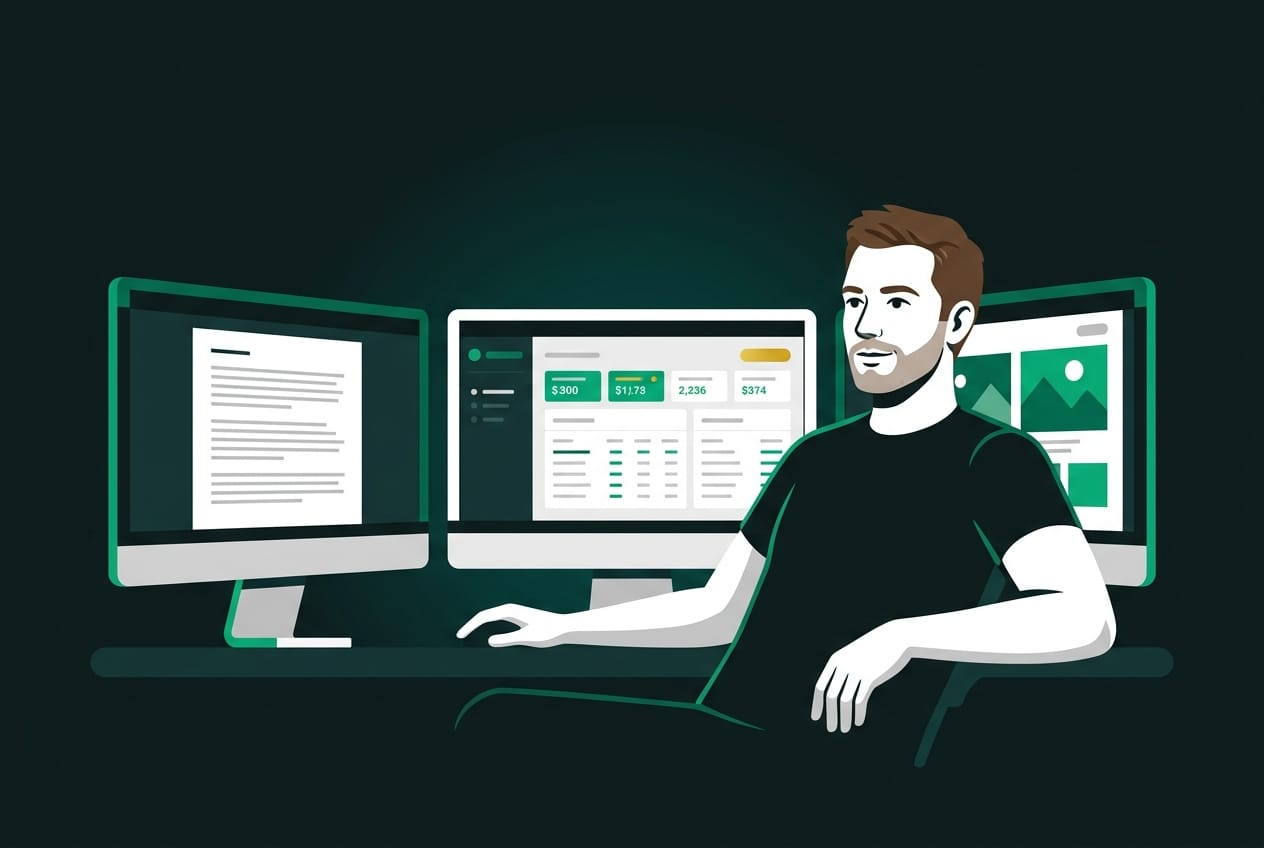
Think of AI not as a set of tools, but as an org chart. In a traditional business, you'd hire people for the following roles. In a one person business, AI fills them, with you as the operator overseeing quality and strategy.
Writer / Content Producer. AI handles first drafts, research summaries, email copy, social posts, and content repurposing. Your role: editorial direction, voice consistency, and final review. The output needs your taste applied to it, but the raw production time drops by 60-70%.
Research Analyst. Market research, competitive analysis, trend monitoring, data synthesis. What used to take a junior analyst a full day, AI does in minutes. Your role: asking the right questions and interpreting what the data actually means for your business.
Customer Support & Communications. Email responses, FAQ handling, onboarding sequences, appointment scheduling. AI handles the template driven 80%. Your role: the 20% that requires judgment, empathy, or complex problem solving.
Admin & Bookkeeper. Invoicing, expense categorization, scheduling, document management. This is where AI saves the most tedious hours. Your role: oversight and the occasional decision that requires human context.
Designer. Visual assets, presentations, social graphics, basic brand collateral. AI image generation and design tools produce 80%-ready output. Your role: creative direction and knowing when "good enough" is actually good enough.
Developer. Automation workflows, landing pages, basic app functionality, data pipelines. AI-assisted coding means you can build and maintain systems you couldn't have touched two years ago. Your role: defining what needs to exist and testing whether it works. You don't need to become an engineer. You need to become dangerous enough to ship functional tools and maintain them.
Can you run a business completely alone? Alone in headcount, yes. Alone in capability, no. You're running a full team's worth of output through AI systems, with yourself as the strategic layer. The complete tech stack for this setup runs under $200 per month. That's less than a day or two of a virtual assistant's time.
The economics aren't even close.
The Operating System (What a Week Actually Looks Like)
Knowing the models and tools is one thing. Knowing what your actual Monday-thru-Friday looks like is another. Here's an example week for a solo operator running a productized service with a content business on the side.
Monday: Client delivery sprint. Four to five focused hours on client work. AI has pre-staged drafts, reports, or deliverables over the weekend. You review, refine, and deliver. Batch your client communication here too: status updates, feedback loops, invoicing.
Tuesday: Content production. AI assisted drafting, editing, publishing. A full blog post or newsletter goes from outline to published in three to four hours when AI handles the first draft and research. You supply the angle, the experience, and the editorial pass.
Wednesday: Sales and pipeline. Outreach, proposals, discovery calls, LinkedIn activity. This is the one day most solo operators try to skip, and it's the one that keeps the business alive. Even with inbound marketing, you need dedicated time for relationship building and conversion.
Thursday: Client delivery sprint #2. Same structure as Monday. Depending on your client load, this is often your heaviest production day.
Friday: Admin, systems, and improvement. Bookkeeping review, process optimization, learning something new, fixing what broke during the week. This is where you invest in making next week easier.
The total: 25-35 focused hours per week. Not 80 hour startup cosplay. A well structured one person business with solid systems runs on focused intensity, not raw volume. AI saves the most time on content production, research, and admin, buying back 10-15 hours per week compared to doing everything manually.
The "but I'll be lonely" objection is real, though.
Working alone full-time can be isolating if you let it. The fix is deliberate: online communities of other operators, a peer accountability group, coworking spaces when you need human contact. Some of the practical solopreneur tips that matter most have nothing to do with revenue and everything to do with maintaining your sanity and perspective.
The Revenue Math (What You Can Actually Make)
Income claims in this space run to two extremes: seven-figure first-year stories, or vague optimism with no math behind it. Here's the honest version, in three tiers.
Tier 1: Replacement Income - $6,000-$10,000/month. You can reach this tier within three to six months if you have a marketable skill and even a small professional network. This looks like two to four productized service clients or one to two consulting retainers. It replaces a solid salary, and for many operators, that's the entire goal. Nothing wrong with that.
Tier 2: Comfortable Independence - $12,000-$20,000/month. Six to eighteen months in. Productized service at or near capacity, plus early content and audience revenue starting to trickle in. At this level, you're earning more than most corporate roles, with 70-85% profit margins because your overhead is minimal. No office lease. No payroll. No benefits administration. Your biggest expenses are AI tools, maybe a contractor or two, and self-employment taxes.
Tier 3: Leverage - $25,000-$50,000+/month. Eighteen to thirty-six months. Multiple revenue streams compounding: services, products, audience monetization, maybe a micro-SaaS tool or two. This tier requires either high-ticket positioning (fractional C-suite work, premium consulting) or genuine audience scale (tens of thousands of engaged followers). It's real, but it's not the default outcome.
The median income for non-employer businesses in the US sits around $50,000 per year according to Census data. That sounds discouraging until you realize it includes every Etsy shop, dog walker, and dormant LLC in the country. Experienced operators in knowledge-work niches consistently outperform that median by multiples. The data doesn't distinguish between someone selling handmade candles and someone selling $5,000/month fractional CMO retainers. You should.
How to Start (If You Already Have the Skills)
Skip the "step one, find your passion" advice. You already have skills people pay for. The transition mechanics are what matter.
Pick one model. Just one, from the section above. Productized services are the safest starting point for most experienced operators because you already know the delivery, the client profile, and the pricing range. You can diversify later. Right now, focus creates revenue. Trying to launch a productized service, a newsletter, and a course simultaneously is how you end up six months in with nothing shipped.
Build the minimum delivery system. What needs to exist before your first paying client? A service description, a price, a way to collect payment, and a documented process for delivery. Not a brand identity, not a full website, not a content library. The minimum.
Get two to three paying clients through warm outreach. Former colleagues, LinkedIn connections, people in your existing network who already know you're competent. Not ads. Not a content funnel. Not "build an audience first." Direct outreach to people who already trust you. This is faster, cheaper, and more reliable than any marketing strategy for your first clients.
Set up the AI stack. Once you have revenue and a delivery process, automate the repetitive parts. AI-assisted content workflows and automated client onboarding are the two highest-ROI starting points. Then expand from there.
Layer in audience building after you have cash flow. Content marketing automation is powerful, but it's a six-month-plus investment. Fund it with service revenue, not savings.
The order matters: revenue first, systems second, audience third. Most people get this exactly backwards and wonder why they run out of money before anything compounds.

What Nobody Tells You (The Hard Parts)
Everything above is true, and none of it is the whole picture.
Sales never stops. You are always the salesperson. Even with inbound marketing, even with referrals flowing in, you are personally responsible for every dollar of revenue. The day you stop selling is the day the pipeline starts dying. If the idea of selling makes you uncomfortable, fix that before you fix anything else.
Isolation is a real risk. Not a certainty, but a default outcome if you don't actively build a peer network. Working alone for months at a time does things to your perspective that you won't notice until someone points them out. Join a community. Get on calls with other operators. This isn't optional.
Income volatility will test you. Month-to-month variance in the first year is significant. A $15K month followed by a $4K month is normal, not a crisis. But it feels like a crisis if you don't have a cash buffer. Build three to six months of expenses before you quit your job. Not after.
AI is a tool, not a miracle. It's a very good tool. It is not a substitute for taste, judgment, experience, or the willingness to do the parts that aren't fun. The operators who treat AI as a shortcut to skip the hard work are building businesses on sand.
Scope creep will murder your margins. A productized service with clear boundaries makes $5,000 per client. That same service with "sure, I can also do that" bolted on makes $5,000 per client and takes three times the hours. Saying no is a revenue strategy.
The Bottom Line
The math has changed. AI has compressed the structural overhead that made going independent a risky proposition for most of the last two decades. One skilled operator now produces what used to require a team.
You don't need more inspiration. You don't need another podcast telling you to believe in yourself. You have a decade of skills, a market that pays for them, and a technology layer that handles the parts you'd otherwise need to hire out.
Pick a model. Build the system. Get your first clients. The rest compounds from there.
What you're building isn't a lifestyle brand or a creator persona. It's a business that runs on your competence, your judgment, and infrastructure that finally makes the economics work for a single operator.

